The programme
Performance education
A racing driver is an athlete, and most of our students have never had access to sports science. So we teach it to them: how to eat, how to train their reactions, and how to look after their bodies. It is all written down in a syllabus that every student keeps when they leave.

The aim
A 16-year-old who can run their own preparation without a coach standing over them.
We are not big enough to be every student’s full-time training staff, and we do not try to be. We see them for a few weeks a year. What we can do is give them the understanding and the tools to do most of this work themselves, at home, between residency blocks and long after their year with us ends.
It is the same idea as our feel-first coaching, applied off the track: a driver who can coach themselves.
The syllabus
Three modules
-
Module 1 Sustainable diets
Lead: Adamo Bianchi
Foundational nutrition for athletes, with the parts that are particular to racing. Why weight matters in a single-seater and how to manage it safely, hydration, energy across a long day at the circuit, and eating well when the season takes you somewhere new.
Most of our students arrive having been told to eat less, or to eat more, by someone with no training to say either. The module starts from the basics of fuelling a growing athlete and only then gets specific about racing.
It is built to be used without us. The recipes travel, the shopping lists work in a supermarket in Lisbon or Tunis, and the plan for a race weekend fits on one page.
By the end, a student can
- Plan the meals for a race weekend, from the evening before to the drive home
- Stay hydrated through a long session and know the signs when they are not
- Understand why weight matters in a single-seater, and why crash diets do more harm than good
- Eat well on the road, in airports and in places where the food is unfamiliar
-
Module 2 Reaction training
Lead: Adamo Bianchi | With Elena Vasquez
A library of drills, a way to make each one harder as you improve, and enough of the theory to understand how reactions are built and kept. Elena Vasquez wrote several of the drills herself.
Reactions can be trained, but only by doing the right work regularly, which is the part that falls away first when a student goes home. So the module is mostly drills: short, measurable, and possible with a wall, a ball and a phone.
Each drill has three or four levels. Students learn the levels, and they learn the reason for them, so they can keep progressing between residency blocks.
By the end, a student can
- Run a reaction session from the drill library with no specialist in the room
- Move a drill up a level, and know when it is time to
- Explain how reactive capacity is built and why it fades without practice
- Keep a simple record that shows whether the work is paying off
-
Module 3 Injury prevention and management
Lead: Adamo Bianchi
How to keep a racing body working for a long career. Recognising early warning signs, the protective routines that matter most (neck conditioning above all), what to do about a knock that does not go away, and how to talk to a doctor or physiotherapist so you get useful help.
This is the module students take home most seriously, because for many of them there is no sports medicine where they live. If they cannot see a specialist, they need to know what a specialist would look for.
Neck conditioning gets the most time. A single-seater loads the head and helmet hard under braking and through fast corners, and a young neck needs to be built for it gradually.
By the end, a student can
- Run a daily neck-conditioning routine, and progress it safely
- Recognise the early signs that something is wrong, before it becomes an injury
- Describe a problem clearly to a doctor or physiotherapist, and ask the right questions
- Plan training around a knock rather than through it
Mind and body cannot be separated, no? Everything is connected.
How it is taught
In the residency blocks, then at home
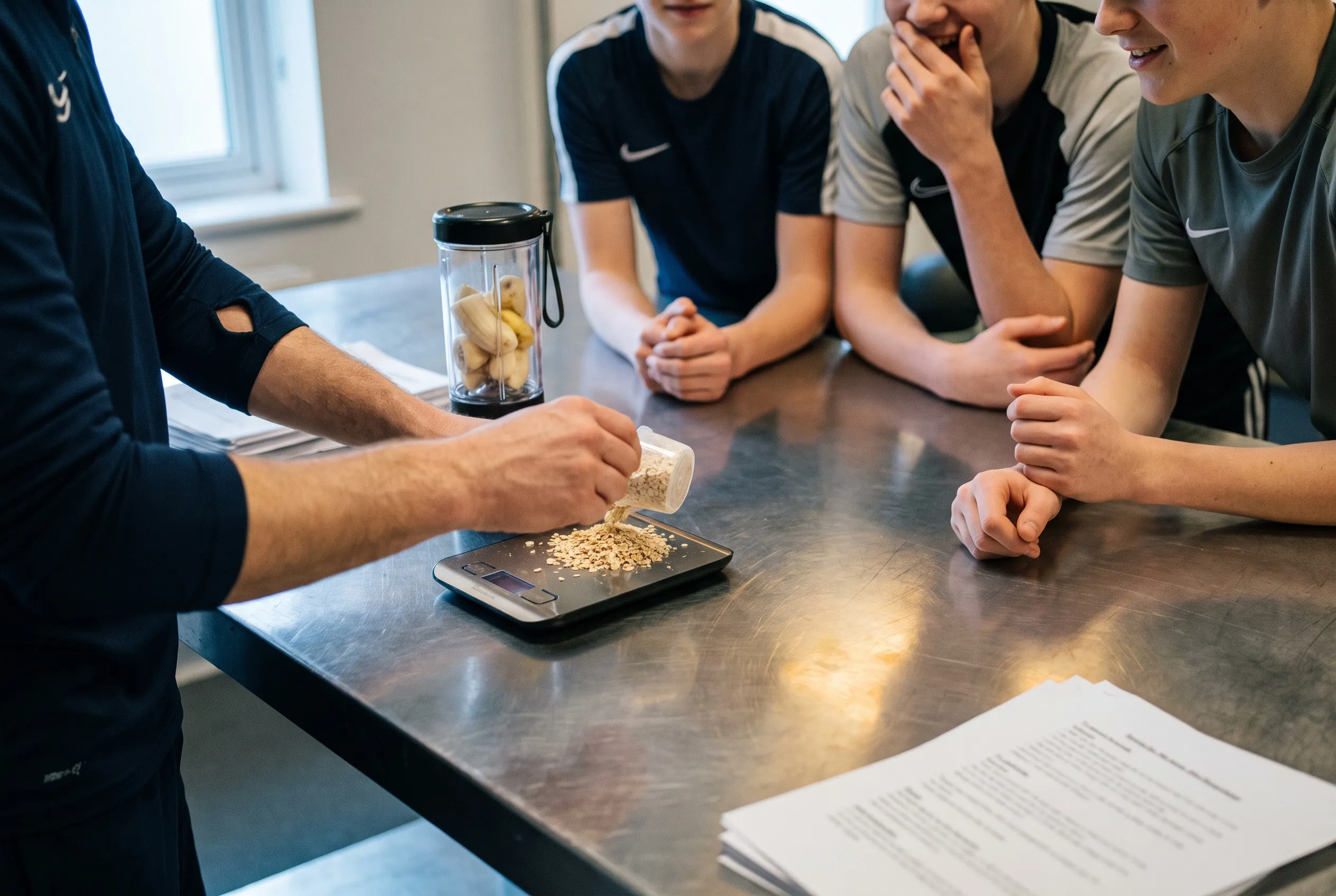
Adamo teaches the syllabus in person during the residency blocks at Modena, a module at a time, with the practical work done there and then: in the instruction room, on the circuit, around the steel table with a blender and a set of kitchen scales. Between blocks, the monthly video check-in covers what each student has been doing on their own.
The syllabus was written by Adamo and Berto Marchetti in the first half of 2027 and has been revised after every cohort since. Students keep their copy when they leave, and every future cohort gets the current edition. In November 2028 the fourth block was given over almost entirely to neck conditioning.
The syllabus at a glance
- Modules
- 3
- Taught in
- Residency blocks, Modena
- Between blocks
- Monthly video check-in
- First written
- 2027
- Written by
- A. Bianchi, B. Marchetti
- Kept by students
- Yes, for good
Who teaches it
Two specialists, one workshop
Adamo Bianchi
Performance Education Lead
Head of Performance, Team AM57. Adamo trained in sports science at the University of Bologna and began his career as a junior strength and conditioning coach at the Ferrari Driver Academy. The syllabus was his idea, brought to us fully worked out. He gives his time to the Foundation as a volunteer.
The students took to him in the first week. His Italian, and his opinions on Bologna’s football, help.
Elena Vasquez
Contributor, reaction training
Performance Coach, Team AM57. Elena specialises in reactive training and cognitive load, and came to motorsport from the performance centre at FC Barcelona’s youth academy and the Spanish Olympic Committee’s training facility. She wrote several of the reaction drills in the syllabus.
Typical? No such thing. Every week is different. But always we have structure inside the chaos.